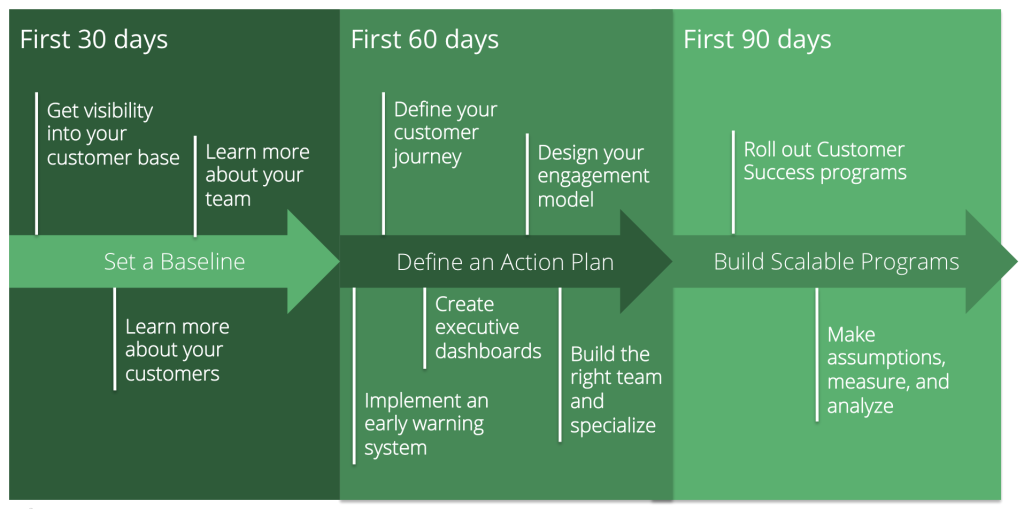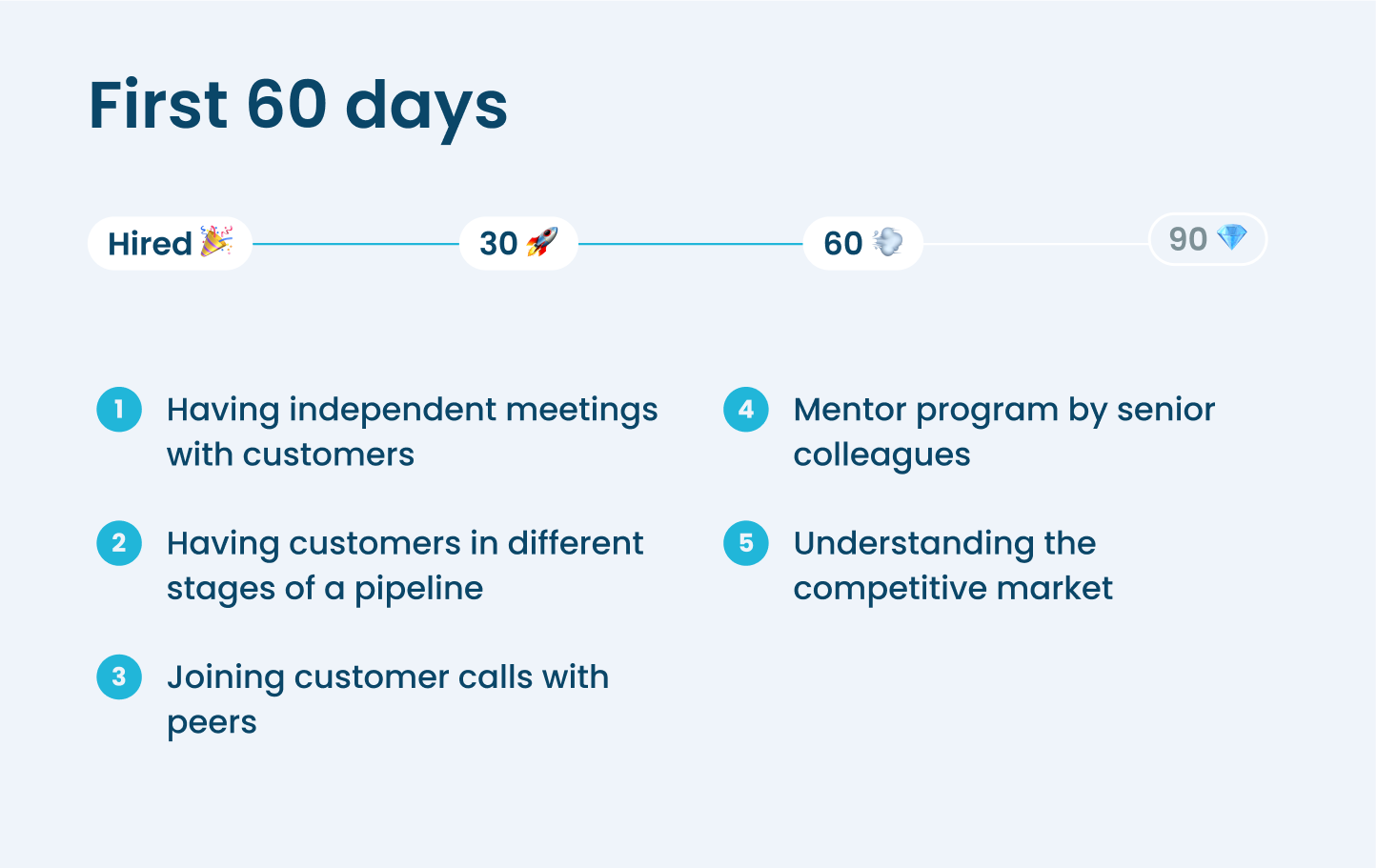
A strong 90-day customer discovery plan should move from learning to validation to decision-making. The most useful structure is three 30-day phases with clear goals, customer conversations, success metrics, and an output at the end of each phase.
A practical 90-day structure
| Phase | Primary goal | Main activities | Success signals |
|---|---|---|---|
| Days 1–30 | Understand the customer and market | Review existing materials, map the customer journey, segment customers, interview customers and internal teams, identify assumptions | Clear understanding of target segments, top pain points, and current journey gaps |
| Days 31–60 | Validate patterns and sharpen the problem | Test the most common needs, compare segments, refine customer profile, gather feedback, identify quick wins | Repeated themes from interviews, clearer ICP, validated problem statements, early opportunities |
| Days 61–90 | Turn insights into action | Prioritize opportunities, propose experiments or solutions, define metrics, socialize findings, set next-step roadmap | Recommended actions, measurable success criteria, stakeholder alignment, next 90-day plan |
What to include in the plan
- Specific focus for each stage, not just broad learning goals.
- Top priorities and the goals that support them.
- Actionable tasks tied to each 30-day period.
- Metrics or success criteria for each phase, using SMART goals.
- Customer segmentation and an ideal customer profile so discovery is aimed at the right people.
- Customer journey mapping to identify gaps, friction, and churn risks.
- Internal alignment with Sales, Product, Engineering, Finance, and other stakeholders.
- Review checkpoints during the 90 days so you can adjust based on evidence.
Example 90-day customer discovery plan
Days 1–30: Learn and observe
- Review existing customer research, support tickets, win/loss notes, and onboarding materials.
- Define the customer segments you want to study and the hypotheses you want to test.
- Conduct discovery interviews with customers and internal stakeholders.
- Map the current customer journey from first contact to renewal or churn.
- Capture recurring themes, objections, and unmet needs.
Output: a working summary of target segments, top pain points, and key assumptions to test next.
Days 31–60: Validate and refine
- Interview more customers in the highest-value segments.
- Compare what you are hearing across segment types and lifecycle stages.
- Refine the customer profile and prioritize the most common problems.
- Identify quick wins or easy fixes that can be tested quickly.
- Define the success metrics you will use to judge each opportunity.
Output: validated problem statements, sharper segmentation, and a prioritized opportunity list.
Days 61–90: Decide and plan
- Turn the strongest insights into proposed experiments, process changes, or product ideas.
- Build a short action plan with owners, milestones, and metrics.
- Share findings with key stakeholders and gather feedback.
- Update the plan based on what you learned.
- Present the next 90-day roadmap or discovery backlog.
Output: a decision-ready roadmap with measurable next steps.
A simple template you can copy
- Objective: What customer discovery question are we trying to answer?
- Segment: Which customer group are we studying?
- Hypothesis: What do we believe is true?
- Activities: What will we do in this 30-day period?
- Metrics: How will we know we learned enough?
- Risks/assumptions: What might be wrong?
- Output: What should exist at the end of the phase?
If you want the plan to be effective
- Keep it concise and skimmable; one to two pages is enough for a working plan.
- Use 30-day increments rather than a single long checklist.
- Make goals SMART so progress can be measured clearly.
- Include both customer-facing and internal discovery work.
- Treat the plan as a living document and update it as new evidence emerges.
If you'd like, I can turn this into a fillable one-page 90-day customer discovery template or tailor it for a specific product, startup stage, or B2B/B2C context.